
20 June 2025
Jaclyn Angela E.A. Rodriguez
Graduate Student, Brooklyn College
Investigating the correlations between America’s two best known presidential assassinations (Kennedy and Lincoln). This investigation recalls primary sources such as documents like medical reports, film, photos, as well as first hand encounters to show how hatred of ideals in presidential office brewed so much so that it would produce the death of the nation’s president. Obscure and common similarities between Kennedy and Lincoln are oft noted, such as Lincoln having a secretary named Kennedy and vice versa, but what bonds of concrete theory and context to both Oswald and Booth would lead to the murders. Review finishes with examination of unity the country after these presidential deaths.

When we think of memorable presidential moments, many can come to mind. From campaigns, to inaugurations, white house briefings, to moments where the presidents show a glimpse of their personality and family lives. None the saddest as when they pass away regardless of your party and your thoughts, the world stops to mourn our fallen leader. But the most heartbreaking is when they are murdered in the prime of their presidential careers.
Britannic defines ‘assassination’ as the “willful killing of a prominent person,” for example, the President of the United States. There have been four occurrences of such in US history, with two recognized in key highlight of American History, with acknowledged consideration to how quickly events transpired, the relation of outreach they formed with their fellow Americans, or the fact their deaths created periods of national unity.
Lincoln and Kennedy deaths shook the core of most Americans and people over the world. The two men, both killed while sitting next to their wives, shared stark similarities in their deaths from names, associates, locations and warnings. We cannot exactly know what creates an assassin, but we can pull together the similar timelines shared, the key reasons why the events occurred and the way it shaped history.
As an avid American History lover, I started studying history as a kid and always indeapth American History. My interest in the assassinations grew out of my love for the dark and creepy edges of History. Recently, I spent time in D.C. and saw Ford’s Theater and really knew I wanted to research this topic. I also found interest in linking together the correlations to see if we can understand and dare I say prevent assassinations. We search for causes leading these different men to want to murder the presidents. Why were they drawn to that point and is there a common thread in all presidential assassinations? I theorize that it was a combination of society, and feeling the shifts in values that made these men want to and then murder our 16th and 35th presidents.
Abraham Lincoln’s Assassination (April 15th-16th 1865)
Entering Ford’s Theater National Historic Site goes into a gift shop attached to the side of the theater. The theater is an active theater which still shows plays, after spending time going through the bottom area of the theater which is now a museum you walk up stairs through a sign that says “Theater” and into a long corridor, which is probably the focal point of this entire museum. It recounts on opposite sides of the walls April 15th for both Lincoln and his assassin John Wilkes Booth. [1]
Lincoln started the day quite happy from what is recalled, Easter was approaching and on all days, Palm Sunday the Civil War ended at Appomattox Courthouse. General Grant had been invited out by the Lincoln’s to celebrate. Note the position of Ford’s Theater in social society at the time, it was thought of to be a seedy place and somewhere you would not want a president to go to. General Grant had declined, on reasons of spending time in New Jersey with his family. Now Lincoln decides to invite Major Henry Rathbone and Clara Harris (an engaged young couple), the couple accepted. In a ominous turn of events. Mrs. Lincoln begins to complain of a headache which was frequent for her and Edwin Stanton (secretary of war) heeds Lincoln about his feelings that he should just not go to the theater tonight and that it could be fatal.
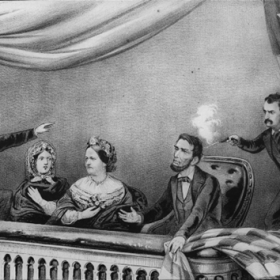
Lincoln felt this was exactly what his family needed after the craziness of the war. The Lincoln’s are reported to have shown up late to the showing of “American Cousin” a satirical comedy about American stereotypes. They would have entered the main doors and taken seats in a booth above the right of the stage and the audience would have clapped and cheered for his arrival. From this point, one can assume a lapse of time in which the Lincoln’s are watching the show. What is known next is these famous last words. “What will she think?” (Lincoln, 1865[2]) . Lincoln was referring to holding his wife’s hand in front of a young Clara moments before Booth comes from behind and fires the fatal shot into Lincoln’s head. In the picture [below][3], a primary source of the attack we see through art what the scene most likely looked like. Lincoln was shot behind and immediately Major Rathbone jumped to aid and save the president, Rathbone suffered a gash from Booth’s dagger. Booth’s weapons as pictured below, were small hence they were easy to sneak in, as well as Booth having a friendliness with the theater (which is later explained) not to mention the saturation of weapons and open carry in the country at the time. It can be assumed that by carrying two weapons, Booth was ready and prepared fully for his mission to kill Lincoln.
What is important to mention here are the small but powerful details. Booth was an actor and had frequented the theater, even so much so his mail was being forwarded to the theater, in a letter with a friend he says he will be at the national hotel, and mail can be forwarded to Ford’s Theater (see Image 4). It was not out of place for him to go in and out of the theater and that is just what he did, he also knew the play well and knew when the audience would be the loudest in laughter to be able to conceal his crime. Booth’s day started with him collecting mail from the theater where he heard of Lincoln’s plans to attend. For Booth this was hitting the lotto, after planning to kidnap and overthrow the government for some while before now, he had the perfect chance. He could do his crime, in a place he knew so well with which he had full access.
It is said he popped in and out of the theater waiting for his perfect moment and that a security guard of Lincoln left to go to the next door saloon for a drink. In between this all, Booth slipped up the stairs across the auditorium and the side, to the back of the balcony where Lincoln was seated and fired the fatal shot.
Booth is then thought to have jumped over the balcony, breaking his leg. But this fact is debated as some believe Rathbone threw him off the balcony. When I asked a docent of the museum he said, yes and that Booth also had his horse ready behind the stage door of the theater for his escape. [4]
What happens next is that a Dr. Leale in the audience goes to the wounded president. Lincoln, who is a tall man, is carried out quickly into the street below. From the porch, Henry Safford, a boarder of the Petersen House, a boarding house where you can rent rooms, calls to bring him in. Lincoln is brought into the back room where he spends the remainder of night dying. He does not speak again and he does not move and is pronounced dead in the following document from Dr. Leale the morning of April 16th “He breathed his last and spirit fled to God” (Leale, 1865)[5]. Now in a funny turn of events, people debate if a border by the name John Mathews whose bed it was that Lincoln passed in, who would have returned in the early morning hours to the house unknowingly climbed into the bloody sheets and fell asleep[6]. [Below] in the image gallery is Leale’s letter where the above quote comes from Leale is one of the first to report on what happened. Leale must have been in shock while penning this letter, describing how he looked for a pulse and how the night went with many people visiting in and out of the room where he lay dying.
In a autopsy we get the full description of Lincoln’s body at death and what happened-
Surgeon General’s Office[7]
Washington City, D.C.
April 15th, 1865
Brigadier General J. K. Barnes
Surgeon General U.S.A.
General:
I have the honor to report that in obedience to your orders and aided by Assistant Surgeon E. Curtis, U.S.A., I made in your presence at 12 o’clock this morning an autopsy on the body of President Abraham Lincoln, with the following results.
“The eyelids and surrounding parts of the face were greatly ecchymosed and the eyes somewhat protuberant from effusion of blood into the orbits.
There was a gunshot wound of the head around which the scalp was greatly thickened by hemorrhage into its tissues. The ball entered through the occipital bone about one inch to the left of the median line and just above the left lateral sinus, which it opened. It then penetrated the dura mater, passed through the left posterior lobe of the cerebrum, entered the left lateral ventricle and lodged in the white matter of the cerebrum just above the anterior portion of the left corpus striatum, where it was found.
The wounds in the occipital bone were quite smooth, circular in shape, with beveled edges. The opening through the internal table being larger than that through the external table. The track of the ball was full of clotted blood and contained several little fragments of bone with a small piece of the ball near its external orifice. The brain around the track was pultaceous and livid from capillary hemorrhage into its substance. The ventricles of the brain were full of clotted blood. A thick clot beneath the dura mater coated the right cerebral lobe.
There was a smaller clot under the dura mater of the left side. But little blood was found at the base of the brain. Both the orbital plates of the frontal bone were fractured and the fragments pushed upwards towards the brain. The dura mater over these fractures was uninjured. The orbits were gorged with blood.
I have the honor of being very respectfully
Your obedient servant.
E. J. J. Woodward
Assistant Surgeon U.S.A.
It seems like the bullet shattered the skull causing multiple blood clots, from the looks at a stained pillow held in the collection at Ford’s Theater, Lincoln bled out a lot. Almost making it impossible to save our 16th president. When I stood in the room he passed in as displayed in the photo attached you could see how unprepared the room was to care for such a traumatic injury (refer to my photo taken at the Petersen House), as well as how small the area was to work in. Lincoln did not even fit on the bed properly, and the first floor is awfully small for everyone who was there for the president. Edwin Staton tried to set up and ended up making a mini office in the living room where Mary Lincoln and actress Laura Keene awaited news from the back room about Lincoln.
John F. Kennedy’s Assassination -November 22nd 1963
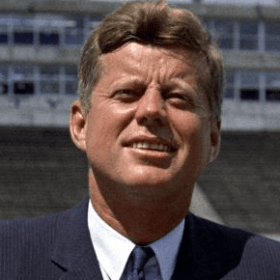
In an attempt to gather support and funds for his campaign, John F. Kennedy also known as JFK made his way to Dallas. It reported the morning was typical, Jacqueline (Jackie) Kennedy started by eating breakfast and talking to the kitchen staff. Later they would commute and talk over the phone to a former vice president wishing him a happy birthday while on the plane to Dallas. In Dallas, JFK and Jackie visited an art museum and then boarded a car to parade down the streets of Dallas with the Texas Governor. The governor commented “You can’t say Dallas doesn’t love you” JFK replied “you sure can’t”. It is important to note that JFK requested to have an open air ride, without the roof. It was also important to note that the route the president took was publicized in the weeks before the event making for a large crowd to come out to catch a glimpse of the Kennedy’s. The open roof made it so much easier for Oswald in a nearby book depository building to shoot and kill JFK. The president slumps over in the seat (as seen in the image gallery) and Jackie tries to jump out, she is pushed in and the car is driven to the nearby Parkland Hospital where he is pronounced dead.[8] Kennedy is young and at his prime with young kids. His body is flown back in a plane where everything that could go wrong does, they cannot find a casket nor the room for a casket aboard Airforce One so they knock seats out and Lyndon B. Johnson his vice president is sworn in next to a very bloody messy looking Jackie Kennedy. His funeral and burial would attract hundreds to D.C. where he is laid to rest in Arlington National Cemetery, with an eternal flame lit by Jackie Kennedy herself.
Who is John Wilkes Booth? His views, His crime
John Wilkes Booth born to a family of Shakespearean actors in Bel Air Maryland, was raised in the arts and became an actor himself. His large family was a well known acting family. Booth had exhibited a passion for the Confederacy of the South. This passion fueled a want to originally kidnap the president and or high government officials on the Union side. This plan included a potential killing of General Grant. Grant was supposed to be in attendance that night at Ford’s Theater. During the play’s third act, of the play of American Cousin[9]Booth entered the presidential box and shot Lincoln through the back of the head. He jumped to the stage, shouting, “Sic semper tyrannis!” (Latin for “Thus always to tyrants,” attributed to Brutus at Caesar’s assassination, Shakespearean Play). It is interesting to see he attributes himself to Brutus as a Shakespearean actor, as he must have embodied his character.
Less than two weeks later, federal agents surrounded a barn in Port Royal, Virginia where Booth and co-conspirator David Herald were hiding. Herald gave himself up but Booth refused and the barn was set afire. Booth suffered a gunshot wound to the neck. In his last moments, he whispered, “Tell my mother I died for my country.” Emptying the dead man’s pockets, the agents found a diary. “Our country owed all her troubles to Lincoln” Booth had written, “and God simply made me the instrument of his punishment.[10]” (Information learned from Library of Congress[11])
In the book Fortune’s Fool; The Life of John Wilkes Booth[12] by Terry Alford. We get a very interesting take on the life of the assassin of our 16th president Abraham Lincoln. Booth grew up in an average family of Bel Air, Maryland at the time, his father was an actor, his mom a stay at home wife and he had numerous siblings. Most importantly his brother Junius who was his main inspiration and friend and sister Asia who pens a tale about him in later years. When his father passes he becomes the man of the house protecting his sister and mother, Junius was much older and on his own away from the family leaving that responsibility to a 15 year old John. John was an up and coming actor himself.
He went to Philadelphia to aid in the booming of his acting career. While there his social circle expanded and he was known to be a friendly face and loving to children. This was short lived however as he would join the confederacy after the Battle of Harpers Ferry[13]. If you don’t recall, the battle of Harpers Ferry was the largest Union or United States soldier surrender moment before WWI, where 13,000 troops surrendered to Stonewall Jackson. This battle gained Confederate enthusiasm, most likely sparking Booth to want to join the cause.
Booth did not have it easy in his early days in the Confederate army as his fellow actor John Brown was hanged and killed for his views in front of a then 20 year old Booth. This moment seems to have changed Booth deeply. [14]But he also had bright moments in his life falling in love with many women. Notable the main one being Ella Wren an actress. Wren left Booth after discovering his violence towards her to be brother in law Pat Redford, a ticket person in the theater both of them worked at. After this records become hazy as we do not know exactly Booth’s life, we do however have a record that he was accidentally shot by a friend in the thigh and the bullet remains lodged for years to come.
As the Civil War grew Booth’s feelings did too. He wanted the Union to remain as it was before the war, he hated abolitionists such as John Brown and Henry Ward Beecher. At this time he did not have a focus on Lincoln. Later though, in 1864 he did start to hate Lincoln, blaming him for the problems he felt the country faced. At this time he moved into Washington D.C. area taking residence at the National Hotel, which is about 5-6 blocks from Ford’s Theater. On Valentine’s Day before the attack he writes to Lucy Hale, a love interest, stating his feelings towards Lincoln. In March before the attack he was already planning on kidnapping Lincoln and did so for 6 months before the attack. In a crazy twist of fate, Lincoln visited Booth’s hotel while Booth was out searching for Lincoln, this time warp pushed back the very imminent threat that Booth wanted towards Lincoln.
As noted above the attack took place quite seamlessly and Booth was argued to have jumped or as Alford defended be pushed by Major Rathbone off the balcony. Regardless he lands on his leg shattering his fibula and ankle. With this injury he still manages to take to horseback and escape the federal agents searching for him. He did so for 12 days!
When found and killed his body remained in a prison for years rotten without a proper burial, eventually it would be returned to the family and buried under their wishes.
In another book “Manhunt” by historian James Swanson[15]. We go into where the last book ended with the assassination of Lincoln. Lincoln has been shot, in the hurries of the moment actress Laura Keene takes to the stage to calm the crowd, who has just heard the shot and watched Booth jump to the stage and run off. While she is taking to stage Joseph Stewart, a playgoer tries to jump and grab Booth slipping and not getting him. The two run off stage together and Stewart is unsuccessful in capturing Booth. Keene relaxes the crowd, assuring the President is alive and makes her way to the Box. She is met their with Dr Leale who is working on the president, a startle unable to walk Mary Todd Lincoln and a few others who think to take Lincoln at first to Keene’s private room and then finally decide that they don’t want the president to pass in such a place as theaters were seen in a more unfavorable manner. The group runs to the street where Lincoln is being carried as blood clots which have formed are dropping out of his wound. In a side note here as someone who gets common bloody noses, a clot stops the bleeding and when clots fall out as they do, it is a disgusting jelly like texture of coagulated blood which then usually causes more bleeding to occur. I do not know the exact size of his clots but they are probably substantial.
At this time they try to gain access to one residence and that fails, they switch and gain access to the Petersen Boarding house as Henry Safford a boarder calls to them to bring Lincoln in. In my memory of the home they would enter a door into a hallway/vestibule area where they would then carry Lincoln back to the last room. He would later as we know pass from his wounds.
During this time the manhunt starts and Booth who is partnered now with Lewis Powell a man part of his network of conspirators against the Union, who has attempted to take the life of William Seward the secretary of state. They are on the run through their network of homes of fellow aides who will help them, The first being the Surratts, a mother son combo who I plan to discuss later. After which they go for medical care for Booth’s broken ankle and fibula to a Dr. Mudd’s house. Mudd provides Booth with crutches and other care, later they would be found at the Garrett Farm’s tobacco barn where Booth is shot and killed. It is important to note Washington D.C. was in a pivotal spot during the Civil War with states to the south being anti union, Pro- Confederate and to the North the Pro-Union side. Booth was almost certain running into the south would save him. This run lasted 12 days, and spanned many miles. He tried his best to remain at large till his finding.
An important note to make here is about conspiracy theories, there are many theories that Booth was not killed and ran off to India after having a wife and child. I will add a piece about that later on for knowledge. But I am sticking mainly to the fact he was captured and killed for my research purposes. Such as the conspiracy of Izola[16], a wife Booth had who went off to India with him after they changed their names and orphaned a child.
In a memoir by Asia Booth Clarke[17], his older sister, she recounts their fairly decent childhood. Asia was close to John and they both were educated as well as gifted in the arts. Asia grew up eventually having many kids herself and recalls their Uncle John rolling and playing on the floor with them, she recalls John’s gentleman like behavior and his love for his family. This painted a picture far from the reality of who a killer was. She only recalls John being weird closer to the act when he left in her safe a packet of letters and money for people and gave instructions to carry out the mailing of these letters if he did not return. Yet she had no clue the pain that would come days later when he kills Lincoln and goes into hiding only to be killed himself 12 days later ripping her heart out of her chest that her sweet little brother could do this.
But Booth wasn’t alone, he worked with a network. One of whom was a mother and southern sympathizer, Mary Surratt[18][19]. Mary is a dynamic force as we do not know the exact actions she had in the case. We know she lived and worked owning a boarding house and tavern in Maryland and D.C., but this boarding house was a haven for those with confederate passions. It seems Surratt and her son loved Booth and had him in attendance a lot around the time of the crime. Booth may have used the house to have secret meetings and it is known Booth runs to Mary’s house after the killing. Mother Surratt was later arrested on charges of conspiracy and hanged. The day she was hunged the older, now sick and frail Mary was carried up to the noose platform, where she cried at the site of the Noose and daughter Anna fainted seeing her mother’s neck wrapped in the noose, came too and her mother was deceased. Anna and a priest tried in the weeks before to prevent President Andrew Johnson from the execution, but he refused. Mary was a devout Roman Catholic who surprised many with her crime, but it also seems at times she may have just been associated with the wrong people. She was the first woman to be executed by the United States Government, her last words “Please, don’t let me fall” (Surratt, 1865)[20] moments before the support under her was knocked out of place and she died. [21]
Who is Oswald?, His Views, His Crime
Lee Harvey Oswald born in October of 1939 and lived his young years in Bronx, New York. He had a rough start to things by age 12 he was already being evaluated by a psychiatrist. Somehow he leveled up and joined the Marines with the sponsorship of his brother.
This is where things took a weird turn, while in the Marines he gained a nickname “Oswaldkovich” as a nod to his obsession with culture and political thoughts of the Soviet Union. He would soon defect to the Soviet Union, where he began to live and met his wife Marina. He had a daughter and moved back to the states where they settled in the Dallas area. It is important to note like in the image [below] Lee showed an increasing obsession for weapons, he was buying guns and other paraphernalia regularly. He even made his wife take photos like the examples below.
The day of the shooting, he was perched in a textbook inventory building where he worked. He got into the building quite easily and seemed to disappear in the time before the shooting, theories say this is when he was setting up his sniper nest. At around 1pm he aimed out the window and fired into the back of Kennedy’s head. He was later caught by cops and famously killed by club owner Jack Ruby who felt it was his duty to avenge the president.[22]
In the book “The Truant” [23]authored by James Norwood, Ph.D describes the crazy weird life young Oswald lived while in New York. Oswald was an average young boy, who went to school regularly and seemed to be doing decently. There is nothing crazy about his school time except when he was charged with truancy. Truancy for those that don’t know is that very real crime of children missing too much school without any sort of arrangement, such as the child needing time off for deaths, sicknesses, and prolonged absences for tragedy events like cancer. The child essentially disappears from the school without any knowledge. Usually schools will call parents and most times it becomes sorted out. In Oswald’s case he did not, based on attendance records, have this problem, yet at 12 he was taken to a mental facility for this reason. Oswald’s family were immigrants and one can wonder if this had anything to do with that. But the effects must have been awful of being in a new, weird, scary and dangerous place for the wrong reasons. Now this is a debated fact about the attendance as you learn in a later source.
Later in life he joins the army and defects to the then Soviet Union where he meets Marina. In the book The Interloper by Peter Savodnik, a free press journalist who has followed hit stories across the globe gives us a glimpse of who Oswald was. Oswald was from a troubled immigrant mother who could not provide for herself let alone her son. While attendance is a debated fact[24], and maybe not true, the fact was that Oswald was constantly pulled from schools and moved. It is not debated that he spent time in a facility. After this he went on to admire the Marxist ways, and USSR. As I was taught by Professor O’Keeffe[25], the Soviet Union and the United States were in a race not only to the moon but to practically everything else, including treatment of citizens. Lee, who had no real family life, was most likely attracted to this selling thought. He tried to join the army to get that feeling filled and just ended up defecting and going to the USSR where he would meet Marina.
Marina was a lifelong resident of the USSR living with her aunt and uncle when she met Lee, a US turned USSR citizen. Marina worked in a pharmacy and the story line is unclear but she ended up meeting Lee through a friend, at the time Lee was hospitalized and sick. She visited him daily waiting for his release. Shortly after Lee met her guardians and the couple married soon after. Lee was her first and everything she was a doting wife. The book goes into great detail of their first married night and how much the couple desired each other. In short Lee took her back to the states and that is where author Priscilla McMillian[26] says things turned weird. Marina felt abandoned in this new home, with a husband becoming increasingly obsessed with weapons, and political activism. But she would never know what faced her at the end of the tunnel when Lee left her a few dollars and went out to kill the president. It altered her life and she felt so deeply for the first family.
Oswald was killed by Jack Ruby[27], an interesting character in and of himself. Theories debate why Ruby killed Oswald but the most concrete one is he was so overtaken with grief and wanting to protect Jackie Kennedy from a long and grueling trial. Ruby was a club owner, who had possible mafia ties who waited for the perfect moment to shoot Oswald in the stomach in an up close and personal murder as seen in the image, located in the image gallery. Ruby later confessed on his deathbed to have not known or really even planned to shoot Oswald; it was just a spur of the moment.[28]
The Warren Comission which comes out of this is piecey and is known for some unfair practices in its making, while more documents surfaced in the early Trump 47th presidency, I decided it would not really add or bolster to my research as I was looking at the assassinations and the social worlds around them as well as connecting the two killers.[29]
What are the similarities?
In a book called “Lincoln-Kennedy Coincidences” by Jonathan Knight[30] expresses the theory of a matrix of events. The intertwined web of small coincidences that add up to seemingly make it through as if history repeated itself. Like Kennedy having a man named Lincoln warn him not to go to Dallas and Lincoln having a man named Kennedy warn him about the theater. How the dates are seemingly matching in both men’s lives. Moreover the freak PH matrix, where Kennedy died at Parkland Hospital, and Lincoln at the Petersen House both starting with a PH. [31]
But on a deeper level both men wanted Civil Rights in the worst way for their fellow Americans. So much so they died for it, delaying civil rights and changing history. They were viewed as the enemy by racist anti-black individuals who were okay with being downright despicable to their fellow human beings due to a skin tone.
We can deeply analyze these two humans and the presidential killings. Both men come from troubled past, both had hatred for changes they saw in their country. The act of wanting to kill someone is intimate. You want to kill someone because you believe you know what they stand for and the values they hold are against your own moral values and beliefs.
One can say troubled passes add to hatred and feeling hated could make one hate more. Oswald and Booth had troubled times and lives. While it seems their problems really took off around the assassinations, one could say their problems link to society. Booth wanted a Confederate Style America where slavery, and the dehumanization that comes along with that are a key part and the centerpiece of it. Oswald was entranced by the glitters that came off the Soviet Union where all humans would be able to be treated equally. These lifestyles that they perceived to be amazing and enthralling were against core American beliefs and values at the time. And who is at the center of American beliefs and values, the presidents whom they wanted to kill. And later did kill. Not realizing that the presidents are only a small fraction in the creation of American Society.
Also as someone who has also earned a degree in anthropology, I am forced to link the two subjects. For both men, bad times are caused somewhat by things out of their control such as a war, or a way of living in the country and the forces of society pushed these men to breaking points, where they did not know what else to do. This is a scary place to be mentally, where you see death as the only answer. Society treated them badly as Oswald spent his childhood in an institution and Booth could never make enough money as an actor. This unfortunately breaks people, and sadly not only did they kill the president but they themselves died in the act.
United States, United to Mourn!
This section begins with a few photos linked at the end to best set the mood about how these tragedy events reached and touched the citizens. When our leader is suddenly taken from us, one can only imagine the pain felt. When Lincoln died in the simple Petersen Boarding House, young immigrant photographers (Ulke Brothers) understood and answered the need to photograph this moment, capturing a famous image of the disheveled bloody death bed Lincoln took his last breaths on. The impact was felt when Ford Theater’s , which became the famous setting of Lincoln’s death, hung black bunting from their doorways. It was felt again when Lincoln’s body made its way to Illinois passing through major cities where Americans took a chance to mourn their beloved President.
How could Americans lose a parental type figure and not feel the pain, there also comes the psychological draw to want to know who, what and why- this done to soothe the mind and try to understand exactly what happened as well. We simply need answers!
But when we cannot find those answers, sometimes we find art. Art is one of the most powerful ways I have seen Presidents who are killed remembered. The first being the hit song Sweet Caroline[32] that is written about the sweet young daughter of JFK, Caroline Kennedy. Even more powerfully his portrait where he is looking ghostly and down, the artist says it was just to make his picture stick out amongst the typical portrait types[33], but one can feel in their heart is it a ghostly image of our departed leader. You feel the sad mood looking at it and knowing his fade adds to that knowledge while observing art which is meant to make us feel and feel differently. As for Lincoln, he is remembered in the gorgeous theatre where he passed. Where you can pick up little knick knacks like an ornament.
He is also remembered in the Lincoln Monument, where you can huff up a thousand steps before realizing there is a ramp! There also seems to be a Lincoln obsession where you can get shirts and stickers, mugs and much more of a cool Lincoln wearing sunglasses.
We also see these deaths as a new era for many Americans, when Lincoln died it was days after the Civil War ended- which Lincoln spent his time trying to unite the country and end the horrors of slavery (even though it did not fully succeeded) . He was cut down at his prime where many were relying on him much like those relying on Kennedy to help end segregation but instead both him and Martin Luther King Jr died trying. Both these presidents fought the same fight in different eras which was that the minorities of the country were treated less than, abused and given no hope in the “land of free” and we can argue that these presidents who stepped out and tried to help their fellow humans were killed for exactly that reason. One could also say these presidents truly took the role of serving all citizens in their actions for an equal and free America.
Effects on Presidency Now
In times when I talk to witnesses of any major American History moment they can all recall the exact thing they were doing when it happened. From my mom recalling answering emergency calls on 9/11, to my dad remembering playing inside during the Newark Riots. Our personal lives somehow become permanently tied to that history.
July 13th 2024 was a hot Brooklyn summer day. After just recently moving and trying to settle into my new house, I went to take a walk to a park. I had headphones on and started to lap the corner close to the park. I heard someone saying “Trump was shot” on their portico porch. I stopped, looked at my phone and could see it was true. I called my partner and said “turn on the tv, turn it on now”. I decked it three blocks to our home, huffing the whole way and slammed my front door open to see the replay of the shot. I am not a Trump fan but I stood in awe, thinking I could have just lived through a assassination.
It is clear we have beefed up security, and that attempts happen always. McKinley’s death ushers in the secret service[34]JFK unites the country in civil rights, Lincoln’s changes history as we know it and Garfield’s changes who gets civil service jobs. But how does it affect presidents today?
I see today how the Trump attempt was used to gain voters. Gaining the ‘aww he almost died for us” votes, it also began quite the talk around social media. Death seems to be a notable way to live and what is more notable then dying leading your country. Herds of diehard Trump fans wore medical bandages to their ears for weeks in solidarity with their president turned presidential candidate. In the book I read for my presentation, “Fight-Inside the wildest battle for the White House” by Jonathan Allen and Amie Parnes[35] is about the crazy race to the 2024 election. We learn that almost every top Democratic Official as well as those in the Republican party knew the moment that a bloody eared Trump stood up screaming “fight, fight, fight” (Trump 2024) the race was called. The American people can admire the fact of his strength giving him an invincible look. After having the unfortunate decline of Biden in the office this is what the people of the United States wanted. A strong looking president.
Besides gathering support for a candidate, it also changes the course of the country. After both presidents died they also took with them the huge amount of change they had planned. Kennedy known as Camelot[36] was ready to take on the Cold War and Civil Rights. Lincoln was in the process of freeing the slaves. It is undeniable that it completely changed history, delaying much needed changes to our country.
During my research I felt pain for both the president and the assassins as knowing in politics everything can be talked out. Maybe if these individuals waited they may have seen the change they wanted in the country. Maybe the presidents were not reaching all citizens correctly (but in reality what president can make everyone happy). I always try to keep an open view and I felt horrible thinking about the killers and what pulsed through their minds. In the end, while it is a horrible event, it is a key part of our history. Being a president is both an honor and the hardest job in the United States. I truly appreciate the brave men and hopefully soon women that take this role on!
[Images Upload Pending]
Meet the Author!
Jaclyn Rodriguez is a graduate student historian in the CUNY system, with degrees in Education, Anthropology, History and experience in mental health and finances. Jaclyn’s passion for American History began as a child growing up near a historical house. This in tangent with her love of museums, art and culture has brought her into the professional field of Humanities. Jaclyn is currently nominated for New England Historical Association Journal and the New England Journal of History. In her free time she spends it with her adorable 6 year old yorkie, Jesse!
[1] Information is learned from Ford Theater Interpretative Staff, Many thanks for their time!
[2] Lincoln’s Last Words 1865
[3] Pictures are all added to a below image gallery
[4] Note here on information- I spend time in the Ford’s Theater Historical Site/Petersen House. While there I looked at their archives and collections. I also spoke to a historian volunteer and staff member (whose name slips me at the moment). I thank the staff and historians of the site for being so welcoming and educating me on this pivotal historic moment.
[5] Image attached at the bottom, Dr Leale Letter on the death of Lincoln, National Archives
[6] This is an almost comedic scene as you can imagine, but an urban legend at that. I personally do not see how someone could be so tired as to climb into a bloody bed.
[7] Surgeon General’s Office Washington City, D.C. April 15th, 186 Brigadier General J. K. Barnes
Surgeon General U.S.A. Letter Describing the autopsy of President Lincoln, National Archives
[8] This is common information known about the Kennedy Case, carried by many and known to me before my research.
[9] The third act of American Cousin opens with Asa Treacher, an overly stereotyped American spending time with his family in England discussing an estate. This is known to be a very comedic scene.
[10] Quotes from Booth are from the Library of Congress Records
[11] Quotes from Booth are from the Library of Congress Records
[12] Alford , Terry. Fortune’s Fool ,The Life of John Wilkes Booth. New York , New York: Oxford University, 2015.
[13] “Harpers Ferry.” American Battlefield Trust. Accessed May 8, 2025. https://www.battlefields.org/learn/civil-war/battles/harpers-ferry.
[14] Alford , Terry. Fortune’s Fool ,The Life of John Wilkes Booth. New York , New York: Oxford University , 2015.
[15] Swanson, James L. Manhunt, 12 day chase for Lincoln’s Killer. New York, New York: First Harper Perennial , 2007.
[16] Cowan, Troy. Izola , 2014.
[17] Booth-Clarke, Asia. John Wilkes Booth , a sister’s memoir , n.d.
[18] Miller, Sarah. Hanged! Mary Surratt and the plot to assassinate Abraham Lincoln. New York, New York: Random House, 2022.
[19] Jones, Rebecca C. The mystery of Mary Surratt . Tidewater, 2004.
[20] Surratt’s Last Words, 1865
[21] There is a photo of Mrs. Surratt lifeless body hanging off the scaffold. As a modern student of history and a modern person I decided not to add this photo out of respect for the family and Mrs. Surratt herself.
[22] This is common knowledge I knew about the case before starting my work.
[23] Norwood, James. The truant, young Lee Harvey Oswald in New York. New Generation, 2025.
[24] There are of course many theories, for my essay I will stick to the importance that Lee was placed in an institution. And that Lee is the one who killed Kennedy, solely and without help. I acknowledge those who deny this, but my documents point to this theory.
[25] Thank you to Professor O’Keeffe for her funny yet true way of telling history during a conversation
[26] McMillan, Priscilla Johnson. Marina and Lee. Hanover, NH: Steerforth Press, 2013.
[27] Fingeroth, Danny. Jack Ruby: The many faces of Oswald’s assassin. Chicago, IL: Chicago Review Press, 2023.
[28] “Jack Ruby’s Deathbed Interview.” JFK. Accessed May 16, 2025. https://www.jfk-online.com/rubydeathbed.html.
[29] Warren Commission Report: Table of Contents.” National Archives and Records Administration. Accessed April 25, 2025. https://www.archives.gov/research/jfk/warren-commission-report/toc.
[30] “Knight, Jonathan Lincoln-Kennedy Coincidences”
[31]“Knight, Jonathan Lincoln-Kennedy Coincidences”
[32] Sweet Caroline, Neil Diamond (1969)- Hit Song dedicated to the daughter of JFK
[33] Image in the image gallery.
[34] “How Mckinley’s Assassination Spurred Secret Service Presidential Protection.” History.com, January 31, 2025. https://www.history.com/articles/mckinley-assassination-created-the-secret-service.
[35] Allen, Jonathan, and Amie Parnes. Fight: Inside the wildest battle for the White House. New York, NY: William Morrow, an imprint of HarperCollins Publishers, 2025.
[36] Kelly, Martin. “The Aftermath of John F. Kennedy’s Assassination.” ThoughtCo. https://www.thoughtco.com/aftermath-john-f-kennedys-assassination-104257 (accessed May 11, 2025).



 The Observations of Jaco